
Is IPTV Legal in Malta 2026? What the Law Really Says
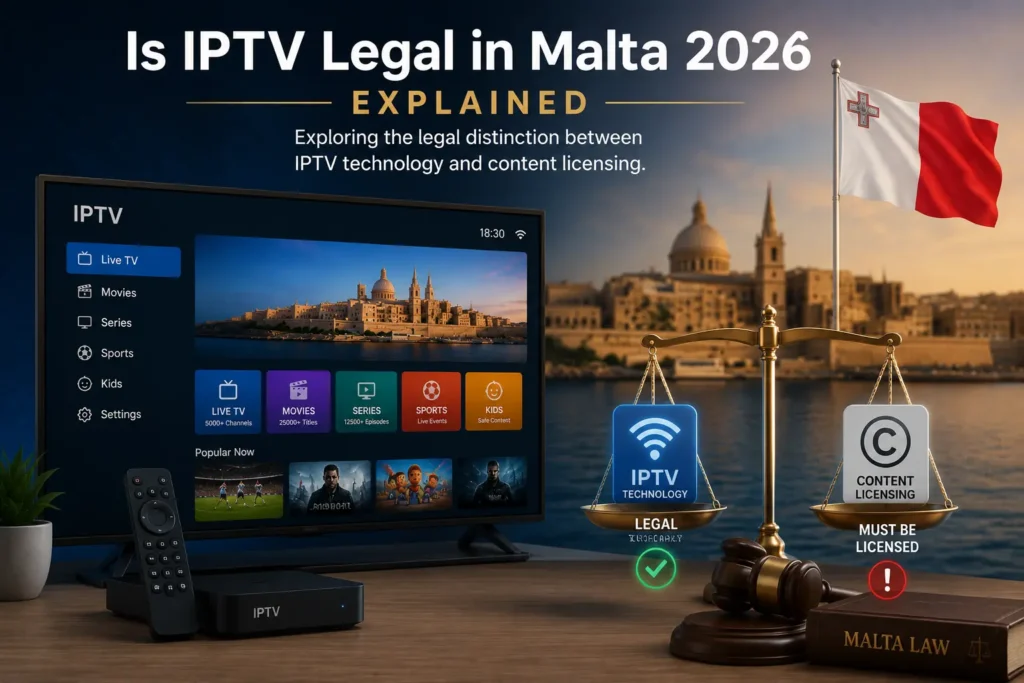
Few questions generate as much confusion online as is IPTV legal in Malta, and the honest answer is more nuanced than a simple yes or no. This guide separates the technology itself from the licensing status of the content delivered through it, giving Maltese consumers a clear framework for evaluating any service. Understanding this distinction matters more than any single headline claim.
Quick Answer
Is IPTV legal in Malta? The technology itself is completely legal, since IPTV is simply a method of delivering video over the internet, similar to any streaming platform. What determines legality is whether the content being streamed is properly licensed for distribution, which depends entirely on the specific provider rather than the technology. This article is for informational purposes only and does not constitute legal advice.
Key Takeaways
- IPTV as a technology is not illegal; it is a delivery method, comparable to any streaming service.
- Legality depends on whether content is broadcast with proper licensing agreements in place.
- Consumers should evaluate providers based on transparency rather than price alone.
- Maltese and EU consumers benefit from general consumer protection and copyright frameworks.
- This article offers general information only and should not replace professional legal guidance.
Table of Contents
- Understanding the Real Question Behind IPTV Legality
- How IPTV Technology Works
- The Legal Distinction: Technology vs Content
- What Maltese and EU Consumers Should Know
- Signs of a Legitimate IPTV Provider
- Signs That Should Raise Concern
- Consumer Risks to Consider
- Best Practices Before Subscribing
- Common Misunderstandings About IPTV Legality
- Comparison: Legitimate Streaming vs Unauthorized Services
- Expert Recommendations for Maltese Households
- Decision Guide: Evaluating Any IPTV Service
1. Understanding the Real Question Behind IPTV Legality
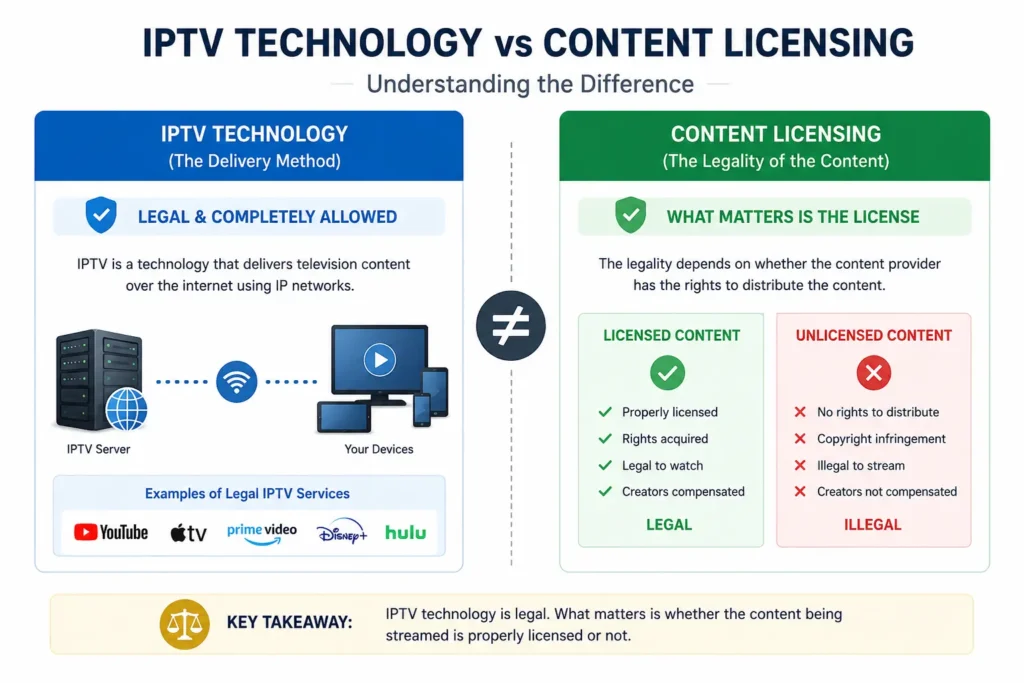
The question is IPTV legal in Malta is often asked as though it has one definitive answer, but the reality requires a bit more nuance.
Why the Question Gets Confused
Many people conflate the streaming method with the content itself, assuming that all IPTV services fall into a single legal category. In reality, the technology and the content licensing are two separate matters entirely.
What This Article Covers
This guide focuses on helping readers understand the distinction clearly, without offering formal legal conclusions about any specific service or provider.
An Important Disclaimer
This article is for informational purposes only and does not constitute legal advice. Anyone with specific concerns should consult a qualified legal professional familiar with Maltese and EU regulations.
2. How IPTV Technology Works
Understanding the mechanics helps clarify why the technology itself isn’t inherently legal or illegal.
Definition of IPTV
IPTV, or Internet Protocol Television, delivers video content as data over an internet connection, rather than through satellite or cable infrastructure. It functions similarly to any major streaming platform.
Delivery Method
Content reaches your Smart TV, Android TV, Apple TV, or Fire TV Stick through an app that organizes channels and on-demand titles into a viewable interface.
Why Technology Neutrality Matters
Just as photocopiers or streaming apps aren’t illegal by design, IPTV as a delivery mechanism is not illegal. What matters is how it’s used and what content flows through it.
3. The Legal Distinction: Technology vs Content
This is the core of the is IPTV legal in Malta question, and it deserves careful attention.
Licensed Content
When a provider has proper agreements with broadcasters and content owners, streaming that content through IPTV is no different from any licensed streaming service.
Unlicensed Content
Distributing copyrighted broadcasts without permission from rights holders raises copyright concerns, regardless of whether it happens through IPTV, cable, or any other method.
Where Responsibility Lies
Responsibility for licensing typically rests primarily with the provider distributing the content, though consumers are encouraged to exercise reasonable diligence when choosing a service.
4. What Maltese and EU Consumers Should Know
This section is for informational purposes only and does not constitute legal advice.
General Copyright Principles
Malta, as an EU member state, generally follows copyright frameworks that protect broadcasters’ and content owners’ distribution rights across the region.
Consumer Awareness
Consumers are generally encouraged to use services that operate transparently and clearly explain how their content is sourced and licensed.
Seeking Clarity
Anyone with specific legal questions about a particular provider should consult a qualified professional rather than relying solely on general online guidance.
5. Signs of a Legitimate IPTV Provider
Recognizing legitimate providers helps consumers make more informed choices.
Transparent Terms of Service
Legitimate providers typically publish clear terms of service, contact details, and information about how their content is delivered.
Responsive Customer Support
A provider offering accessible, responsive customer support is often a positive indicator of a professionally run service.
Consistent Streaming Quality
Reliable providers tend to offer consistent HD Streaming, Full HD Streaming, or 4K Streaming quality, since properly sourced content is usually delivered through stable infrastructure.
6. Signs That Should Raise Concern
Unrealistic Pricing
Prices dramatically lower than any licensed streaming alternative can sometimes indicate a lack of proper content licensing.
Lack of Transparency
Providers that avoid clear contact information or refuse to explain how content is sourced warrant additional caution before subscribing.
No Verifiable Business Presence
A legitimate business typically has a traceable online presence, published policies, and consistent communication channels.
7. Consumer Risks to Consider
Service Reliability
Unlicensed content sources are sometimes shut down abruptly, leaving subscribers without service and without recourse.
Payment Security
Using unfamiliar or untraceable payment methods with any online service can carry inherent financial risk.
Data Privacy
Choosing providers with clear privacy policies helps protect personal information shared during signup.
8. Best Practices Before Subscribing
- Research the provider’s reputation and read independent reviews where available.
- Confirm the provider offers clear terms of service and contact information.
- Test the service, where possible, before committing to a long-term plan.
- Use secure, traceable payment methods rather than unusual transfer requests.
- Consult a legal professional if you have specific concerns about a provider.
9. Common Misunderstandings About IPTV Legality
- Assuming all IPTV services are automatically illegal because of the delivery method.
- Believing that low price alone confirms a provider is operating without proper licensing.
- Confusing personal streaming use with content redistribution, which are legally distinct matters.
- Overlooking that legitimate, licensed IPTV services do exist and operate transparently.
- Assuming general online guidance replaces professional legal advice for specific situations.
10. Comparison: Legitimate Streaming vs Unauthorized Services
| Factor | Legitimate Streaming Service | Unauthorized Service |
|---|---|---|
| Content Licensing | Properly licensed agreements | Licensing status unclear or absent |
| Transparency | Clear terms and contact details | Limited or no verifiable information |
| Pricing | Reflects licensing costs | Often unrealistically low |
| Reliability | Stable, consistent service | Prone to sudden shutdowns |
| Consumer Protection | Generally stronger | Often limited or unclear |
11. Expert Recommendations for Maltese Households
Prioritize Transparency
Choose providers that clearly explain their service, publish terms of use, and maintain a verifiable business presence.
Verify Before Committing
Take time to research a provider’s reputation rather than subscribing based solely on price or convenience.
Stay Informed
Regulations and industry practices can evolve, so periodically reviewing your provider’s terms is a reasonable habit for any household.
12. Decision Guide: Evaluating Any IPTV Service
Checklist Before Subscribing
- Does the provider publish clear terms of service and contact information?
- Is the pricing reasonable compared to other licensed streaming options?
- Does the provider have a traceable, verifiable business presence?
- Have you reviewed independent feedback about the service’s reliability?
Final Recommendation
When approaching the question is IPTV legal in Malta, the safest path is prioritizing transparency and doing reasonable diligence on any provider, rather than assuming legality based on price or popularity alone. For specific legal concerns, consulting a qualified professional remains the most reliable approach.
Conclusion
The question is IPTV legal in Malta ultimately comes down to distinguishing technology from content licensing. IPTV itself is a legitimate delivery method, but the legality of any specific service depends on whether its content is properly licensed. Maltese consumers are best served by prioritizing transparency, doing careful research, and remembering that this article offers general information only, not formal legal advice.
FAQ
1. Is IPTV legal in Malta in general?
IPTV as a technology is legal, since it simply delivers video content over the internet, similar to any streaming platform. What matters is whether the specific content being streamed is properly licensed. This article is informational only and does not constitute legal advice for any individual situation.
2. What makes an IPTV service illegal?
An IPTV service becomes legally questionable when it distributes copyrighted content, such as premium broadcasts, without proper licensing agreements from rights holders. The delivery method itself isn’t the issue; the licensing status of the content determines legality.
3. Can I get in trouble for using an IPTV service?
This varies by circumstance and isn’t something this article can determine definitively. Consumers concerned about their specific situation should consult a qualified legal professional rather than relying on general online information.
4. How do I know if my IPTV provider is legitimate?
Look for transparent terms of service, verifiable contact information, reasonable pricing compared to licensed alternatives, and responsive customer support. Providers lacking these elements warrant additional caution before subscribing.
5. Does the EU regulate IPTV streaming?
The EU generally maintains copyright frameworks that apply across member states, including Malta. This article doesn’t cite specific statutes and recommends consulting official EU or Maltese legal resources for precise regulatory details.
6. Is watching IPTV the same as illegally downloading content?
These are legally distinct activities with different considerations. Streaming and downloading involve different technical processes, and neither is addressed definitively here; specific concerns should be directed to a legal professional.
7. Why are some IPTV services so much cheaper than others?
Pricing differences can reflect various factors, including licensing costs. Services significantly cheaper than standard licensed alternatives may warrant additional research before subscribing, though price alone doesn’t confirm a provider’s legal status.
8. Are there legal IPTV services available?
Yes, legitimate IPTV services exist and operate with proper content licensing, similar to any authorized streaming platform. Transparency, clear terms of service, and verifiable business practices are good indicators of legitimacy.
9. What should I do if I’m unsure about a provider’s legality?
Research the provider’s reputation, review independent feedback, and consider consulting a qualified legal professional if you have specific concerns. This article provides general guidance only and isn’t a substitute for personalized legal advice.
10. Will IPTV regulations change in the future?
Regulations can evolve over time as streaming technology develops. Staying informed through official sources and periodically reviewing your provider’s terms is a reasonable practice for any household using IPTV services.
Suggested Internal Links
- Learn more about our IPTV subscription options in Malta.
- Check full device compatibility for IPTV apps.
- Find more answers in our FAQ page.
- Learn more about us on the About Us page.
- Have questions? Visit our Contact page.
- Return to the IPTV Malta 4K homepage.